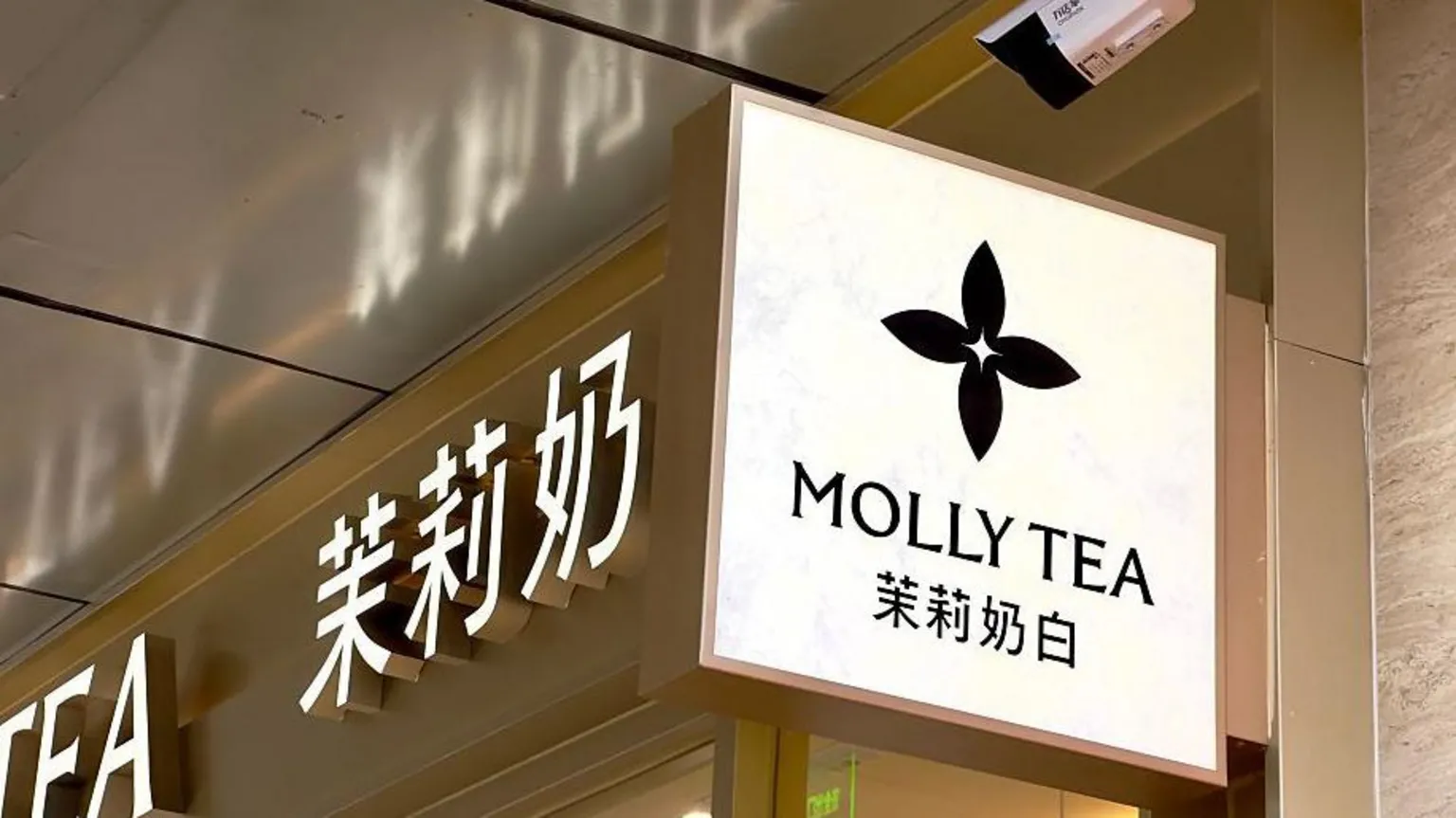
In contemporary consumer culture, the line between luxury and everyday utility has largely vanished. We live in an era where high-fashion houses partner with fast-food chains, skate brands drop luxury luggage, and hyper-niche lifestyle drops happen weekly. So when a consumer sees a stylized four-petal floral emblem on a cup of jasmine tea, their first instinct isn’t necessarily to wonder whether a tea shop copied a historic fashion house. Their first instinct is often: Is this an official collaboration?
That exact cultural conditioning sat at the heart of a recent intellectual property dispute in China. Molly Tea, a fast-growing beverage chain founded in Shenzhen in 2021 that now boasts over 2,000 stores globally, was ordered by a court in Jiangsu province to pay 10.3 million yuan (roughly $1.5 million) to Louis Vuitton. The cause? Using a four-petal emblem that the court ruled infringed upon Louis Vuitton’s iconic monogram trademarks.
Beyond the financial penalty—10 million yuan for economic losses and 300,000 yuan in legal expenses—the court required a remedy that strikes directly at brand equity: a mandatory corrective statement published across six of Molly Tea’s primary digital touchpoints, including its official website, WeChat mini-program, Weibo, WeChat, Xiaohongshu, and Douyin.
The ruling sparked immediate debate across Chinese social media, generating hundreds of millions of views on Weibo. The core question circulating online went beyond legal semantics: How can a luxury leather goods legacy hold exclusive rights to a floral motif against a mass-market tea brand operating in an entirely different consumer category?
The Collapse of Category Separation
To understand why this decision landed with such force, one has to look beyond strict trademark classifications and observe how modern audiences process brand signals. Historically, trademark enforcement hinged heavily on direct category competition—would a customer confuse a handbag with another handbag?
However, modern legal frameworks and market realities increasingly accommodate cross-class protections for famous marks. In a retail climate where luxury houses regularly launch pop-up cafes, co-branded apparel, and lifestyle accessories, strict category isolation no longer shields emerging brands from legal exposure.
When visual identity overlaps across sectors, modern consumers rarely assume coincidence. Instead, they assume affiliation. Has the luxury brand licensed its mark? Is this a limited-time partnership? The moment a visual motif creates that subtle hesitation, brand equity is being leveraged—whether intentionally or organically.
Critics of the ruling argued that four-petal floral motifs are deeply embedded in traditional Asian decorative arts and historical design. Is it reasonable for a single global brand to claim broad ownership over a basic geometric shape from nature?
It is a compelling argument. Yet in contemporary branding, context dictates meaning. When a specific shape becomes inextricably linked with decades of high-end positioning and cultural repetition, it ceases to be mere geometry in the eyes of the market. It becomes a commercial symbol.
The Operational Aftershocks of a Forced Rebrand
Faced with the judgment, Molly Tea quickly set a visual pivot in motion. The brand reportedly moved away from its black-and-white visual identity toward a purple and gold palette, adopting a more three-dimensional emblem designed to create distinct separation from Louis Vuitton’s flat monogram motif.
For a business scaling aggressively across international markets—including the United States, Canada, the UK, Australia, Thailand, Indonesia, and Singapore—a sudden identity shift is far more than a aesthetic refresh. It is a massive operational burden. Storefront signage, packaging lines, mobile UI, social templates, and franchise guidelines must all be overhauled simultaneously.
Recognizing the stakes of global exposure, Molly Tea has also moved to hire an IP-focused legal manager to oversee trademark systems, administrative disputes, and global IP strategy. As brands cross borders, their visual assets are exposed to varying legal regimes, heightened scrutiny, and relentless comparison. Building IP governance becomes a fundamental growth capability rather than a compliance checkbox.
What Brand Leaders Should Consider
This case offers several sharp insights for executives, strategists, and creative leaders navigating visual identity today:
Cross-category immunity is a relic of the past. Operating in a completely different industry no longer provides automatic protection if your design cues mimic a famous mark in an era defined by unexpected collaborations.
Owned digital channels are legal surfaces. Requiring public apology statements on a brand’s native apps and social feeds underscores that digital channels are treated as primary public records, not just marketing distribution tools.
Visual borrowing creates structural fragility. Building initial brand momentum on visual assets that carry trademark ambiguity creates systemic risk. Changing an identity under court mandate is exponentially more expensive and public than investing in rigorous IP strategy early on.
Reframing Visual Identity in a Shared Culture
The conflict between Molly Tea and Louis Vuitton isn’t simply a story about tea cups or floral monograms. It is a snapshot of how visual culture operates in an interconnected marketplace.
As competition intensifies across consumer categories, the temptation to lean on familiar aesthetic codes and luxury tropes is understandable. But lasting distinctiveness requires constructing an original visual language rather than standing in the shadow of existing ones.
In a world where audiences are trained to read every visual cue as a potential partnership, identity is never just decoration. It is a strategic assertion of who you are, what you stand for, and where your brand begins and ends.